

FAQs
ITC Specific
Q. What is Illumination Technologies?
A. Illumination Technologies California specializes in municipal public safety solutions. Our focus is building and deploying effective detection, monitoring and notification systems for cities and towns that are at high risk for wildfires and other potential natural disasters. We also partner with cities and municipalities to create build-to-suit turnkey solutions for wireless infrastructures that enable deployment of the latest wireless and Smart City technologies.
Q. Where are you based and who is your leadership team?
A. Illumination Technologies California is based in Calistoga, CA at the top of the Napa Valley. We have directly experienced the impact of wildfires and are committed to giving other cities and towns the tools to help address and mitigate a natural disaster challenge. The company is backed by private investors and led by our CEO, Christopher Eldridge.
Q. I’m not familiar with your company. What experience do you have in doing this?
A. We are the sister organization of the largest private telecommunications infrastructure provider in Latin America. Continental Towers has partnered with nearly 5,000 municipalities in Central & South America, South Africa, the Philippines and the United States. We have over 18 years of operational experience, deploying over 4,800 telecom structures and sites with continued growth internationally.
Q. What is your public safety solution?
A. Our end-to-end solution supports emergency response teams by helping accelerate their response time while also preserving public safety through community-wide alarm systems. Once a fire or hazard is detected, emergency responders are immediately notified. Siren alarm site locations, selected based on a sound map study, warn the public, alerting them of any necessary precautions.
Q. How much does this cost?
A. Illumination Technologies offers numerous financing options. We offer our public safety technology solutions directly at competitive rates as a service provider, but we also specialize in developing innovative partnerships. We partner with municipalities to provide a wireless telecom infrastructure with public safety benefits at the lowest costs possible to cities or residents. In certain cases, costs can be covered by creating multi-purpose structures that are leased to telecommunications carriers to deploy their wireless services as part of the system sites, thereby also helping enhance local cellular service.
Q. Does this result in a lot of towers and “visual pollution”?
A. We incorporate unique pole design concepts that are intended to blend into an area’s natural setting. With multi-purpose structures that also accommodate multiple telecommunications carriers, we help minimize the overall number of sites and poles necessary for local wireless telecom coverage. This helps preserve the visual landscape and minimizes unsightly facilities.
Q. How loud will the siren be? Will we all be able to hear it?
A. In a natural disaster situation (such as wildfire or earthquake), emergency sirens are activated to warn the public and alert them of any necessary precautions.
Decibel level, as well as placement, of sirens are critical for an effective public emergency warning system. To achieve optimal sound coverage, the sirens that we use are in the 70-80 decibel range(relative to your proximity). To put that into context:
70 decibles = passenger car at 65 mph (at 25 feet)
80 decibles = freight train (at approx. 50 feet)
[80 dB is actually two times louder than 70 dB.]
Q. Does your wireless infrastructure support next-generation technologies like 5G?
A. We create build-to-suit solutions according to the stated needs and requirements of the municipality, while maintaining FCC compliance and supporting our telecom-carrier infrastructure tenants. We are able to support the latest technologies, which could include 5G if required.
5G Specific
Q. What exactly is 5G?
A. 5G stands for “5th generation” and represents the latest evolution of wireless connectivity. It is considered a major shift in wireless technology and a leap ahead of the current 4G.
As billions more devices connect to the web and the Internet of Things comes into full realization, the entire wireless network infrastructure needs to accommodate this traffic to meet an enormous demand - not only to support faster, more seamless connections but also to better handle simultaneous ones as well as provide broader coverage. This shift requires an upgraded network and infrastructure.
5G is the next step forward and is expected to have a significant impact on how individuals access the Internet, how companies manage their devices, and the types of services wireless carriers can provide.
Q. Are there any technology standards for 5G?
A. For a network to be considered 5G, it has to abide by certain rules set by governing authorities like 3GPP. One of those specifications is speed for uploads and downloads. There's a minimum peak download rate and a minimum peak upload rate for a network to be called a 5G network, meaning that each 5G base station has to support speeds at least this fast:
5G peak download speed: 20 Gb/s (gigabits per second), or 20,480 Mb/s (megabits per second)
5G peak upload speed: 10 Gb/s (gigabits per second), or 10,240 Mb/s (megabits per second)
5G also has a minimum latency requirement. Latency refers to the time lapse between when the cell tower sends data and when the destination device (like your phone) receives the data. 5G requires a minimum latency of just 4 ms, assuming that ideal conditions are met, but could drop as low as 1 ms for some forms of communication, particularly ultra-reliable and low-latency communications (URLLC).For comparison, latency on a 4G network might be around 50–100 ms.
Q. What’s the difference between 5G and 4G?
A. 5G will follow (but not replace) current 4G networks with vastly increased capacity, lower latency (i.e., response time), and faster speeds. There are numerous variables that can affect speed, but 5G can run anywhere from 10 to 20 times faster than 4G. And latency can be reduced to milliseconds.
Here’s an example: You download a movie that's 3 GB in size. Here's how long it might take to download it on different kinds of mobile networks (using realistic speeds, not peak speeds):
3G: 1 hour, 8 minutes
4G: 40 minutes
4G LTE: 27 minutes
5G: 35 seconds
5G uses different kinds of antennas, operates on different radio spectrum frequencies, connects many more devices to the internet, minimizes delays, and delivers ultrafast speeds. That’s why it requires a different kind of network infrastructure. Many of the major wireless carriers are already piloting 5G in various cities, but broader availability is still to come.
Q. How do I know if or when I’ll be getting 5G in my area?
A. That is a question for your local wireless carriers.
Q. Is 5G harmful to our health?
A. Health concerns have been a discussion point even before the advent of 5G and relate to electromagnetic radiation. Like the radiofrequency energy emitted by phones, this can be categorized into two types: ionizing radiation (e.g., X-rays and cosmic rays) and nonionizing radiation (e.g., radio frequency). Exposure to ionizing radiation has been known to increase the risk of cancer.
Radio spectrum frequencies are broken up into bands, each with unique features as you move up into higher frequencies. One fundamental difference between 4G and 5G is 5G’s use of unique radio frequencies and millimeter wave technology to achieve what 4G networks cannot.
Typical 4G cell networks transmit at frequencies such as 700 MHz and 2.5 GHz, well below the much higher wavelengths of things like X-rays and gamma rays from medical devices and radioactive treatments. Some of the new 5G networks will use higher bands, in the 30 GHz to 300 GHz range, butwhich still do not emit ionizing radiation like x-rays and gamma rays. Millimeter wave technology, at the higher end of the spectrum, has safely been used in technology such as radar for many decades.
In terms of cell towers, because the higher millimeter wave of 5G does not easily penetrate objects, this requires the installation of “small cell” antennas every 500 feet. This kind of array, however, would be utilized more in high density traffic areas (such as urban environments) or to better support the use of smart technologies.
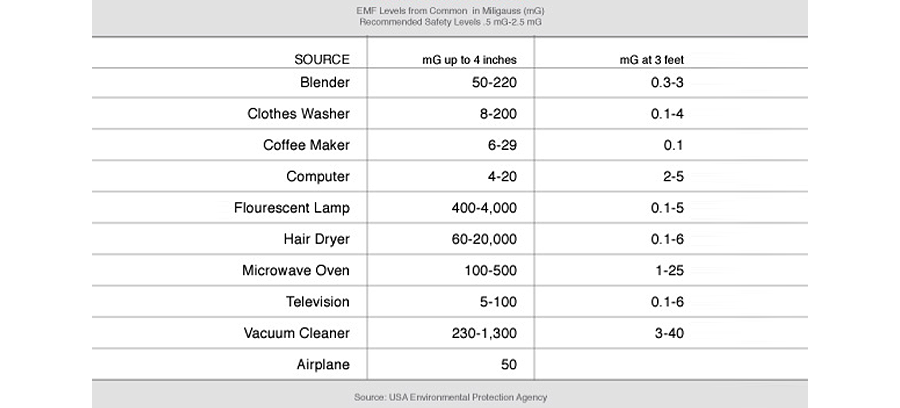
For greater context, bear in mind that many common items in our lives are also sources of radiation.
For example:
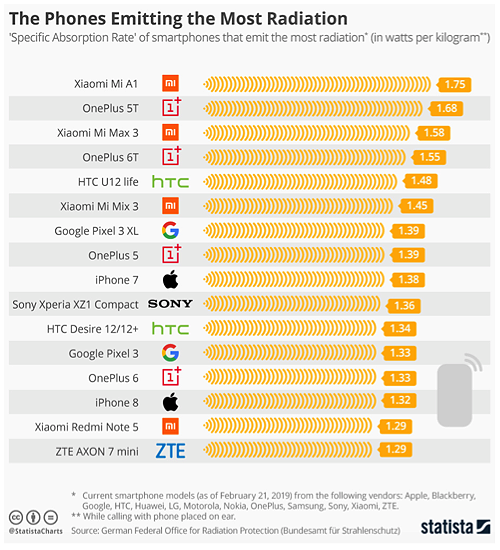
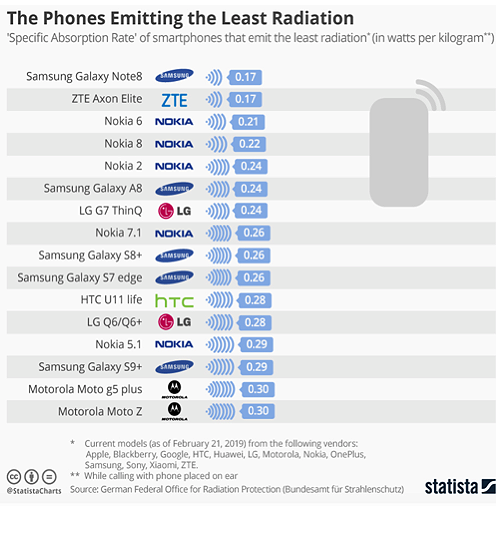
Smartphones are probably the most ubiquitous devices and can cover a range of frequency emissions. These phones are ranked by the specific absorption rate (SAR)—when calling with the phone placed to the ear—which is expressed in watts per kilogram of body weight. The human body absorbs energy from devices that emit radio frequency electromagnetic radiation, like phones, and the dose of the absorbed energy is estimated using the SAR measure, according to the National Cancer Institute. Up to 90% of an individual’s exposure to radiation can come from a person’s own mobile phone.
Q. What about 5G cell towers (or small cells)? How different are they?
5G promises an extremely interconnected world where everything from smartwatches, vehicles, buildings, farms, remote medical services, etc. utilize the ultrafast speeds and low delays it offers. To accomplish this and to do it well — with as little coverage gaps as possible — it’s required to have a large number of 5G towers, particularly in areas that demand lots of traffic like big cities and business districts.
Another reason 5G towers have to be installed so frequently in busy areas is that for the small cell to support superfast speeds, it has to have a direct line of sight with the receiving device. Since 5G cell towers are so small, they can be positioned in ordinary places like on light poles, the tops of buildings, street lights, etc. For 5G to really excel in a highly-populated city, for example, especially given its short distance limitations, towers need to exist close to wherever connected devices will need access to them, like at intersections, near businesses and buildings, around college campuses, down the street, etc.